
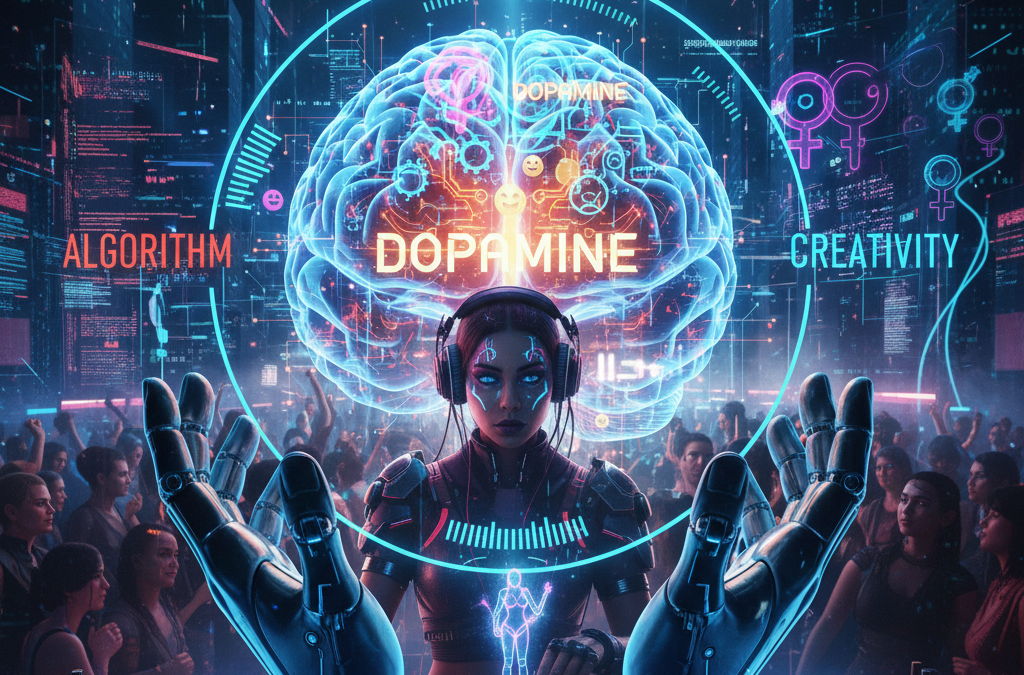
Determining who decides the music you listen to requires an analysis of both neurobiology and corporate strategy.
On the one hand, music serves as an authentic reflection of our inner selves. It triggers the release of dopamine, a neurotransmitter synthesized from amino acids that regulates biological functions. Consequently, this neurochemical vulnerability allows the industry to treat human emotion as a quantifiable metric.
On the other hand, the music industry has commodified the younger generations’ rebellion into a marketable social protest. This protest follows fashion aesthetics that require no real critical thought. Therefore, listeners often overlook the reality that a powerful oligopoly — Universal, Sony, and Warner — systematically conditions public preference to minimize financial risk.
This strategic manipulation creates a fictitious cultural landscape where commercial success is mistaken for artistic quality. Modern hits frequently promote effortless luxury and treat sex as a transactional game.
Furthermore, they facilitate the objectification of both genders, though women remain the primary subjects.
The Romantic Misogyny
Elvis Presley became the first solo artist in history to sell a million records. The fan phenomenon grew significantly during the 20th century thanks to his massive influence. This period illustrates the emergence of younger generations as a distinct market niche.
The king of rock-and-roll synthesized African American rock and roll structures with a standardized white sex appeal. He aimed to satisfy the cultural norms of a segregated era. Moreover, the music industry at this point still valued rhythmic innovation.
His hits generated immense energy and transformed him into a controversial cultural icon. Nevertheless, his lyrics often relegated women to a subordinate level. We see this evidenced in «(You’re the) Devil in Disguise» or the reductive plots of his cinematic work.
Path to Female Independence
The Beatles were essential catalysts for the cultural movements of the 1960s. Their compositional output integrated classical elements with traditional pop. Eventually, they explored diverse styles such as Indian music, psychedelia, and hard rock.
The Beatles acted as pioneers in the fields of studio recording and artistic presentation. Their early period adhered to patriarchal norms involving themes of jealousy. Conversely, their later work transitioned toward the advocacy of female autonomy.
A clear contrast exists between «You Can’t Do That» (1964) and «Lady Madonna« (1968). The first centers on social humiliation and the prohibition of female agency. The latter serves as an anthem for the working-class mother, acknowledging her resilience.
Gender-Subversive Paradigm
Queen‘s repertoire represents the pinnacle of innovation in the acoustic music scene. Freddie Mercury embodied a subversive talent that transcended his four-octave vocal range. Specifically, «Bohemian Rhapsody« posed a direct challenge to an industry prone to simplification.
Queen is complex and manages to reach the masses with experimental song structures. Overall, the band successfully combined ballads, opera, and hard rock. Mercury challenged traditional heteronormative masculinity through his public persona.
The «I Want to Break Free» video depicted the band in domestic female roles. This served as a powerful visual metaphor for the desire for liberation. Mercury used his platform to dismantle social constraints through theatrical performance.
Sophistication of Toxic Narratives
Sting represents the introduction of intellectualism and jazz into the pop sphere. His lyrics possess literary weight, and his music remains technically complex. The industry facilitated his success because his virtuosity remained profitable.
He operated like a scientist, experimenting with melodic structures to produce hits. However, his repertoire was not exempt from misogyny. This is best illustrated by the stalker narrative found in «Every Breath You Take.«
Toxic possessiveness was accepted without question during that era. Consequently, the industry successfully transformed a predatory sentiment into a romantic ballad. This demonstrates how high-level art can still harbor regressive social values.
Challenging the Patriarchal Norms
Depeche Mode became the primary architects of technopop for the masses. They questioned traditional masculinity by adopting an androgynous aesthetic.
This visual strategy deconstructed gender boundaries and aligned the band with a non-binary identity. They challenge the «macho» status quo. Two specific examples of their substantive hits follow:
- Exploration of power exchange in «Master and Servant» (1984).
- Critique of the «savior» archetype in «Personal Jesus» (1989).
Strategic Marketing and Algorithms
The Bad Bunny phenomenon demonstrates how minimal creative effort can be optimized for maximum corporate profit through an absolute mastery of market behavior. Analyzing this from a marketing perspective shows that his success is the result of a precise alignment with his listeners’ desires. Indeed, this phenomenon confirms that reaching an audience requires understanding the specific context and psychological state of the receiver, whether in a high-level academic debate or within the hedonistic atmosphere of a nightclub.
Both the algorithmic model and the strategic narrative rely on the same fundamental principle of communication: the necessity of decoding the audience’s language to ensure resonance. While Bad Bunny utilizes repetitive structures to dominate the global charts, my research explores how that same principle of understanding can be applied to re-engineer human narratives in more complex spheres. Ultimately, the music industry reflects a broader truth about our era; success is determined by the ability to infiltrate the audience’s consciousness through a tailored strategic approach.
These two approaches represent different standards: one seeks mass-market dominance, while the other prioritizes the engineering of a disruptive narrative.
Specifically, «Tití Me Preguntó« exemplifies the hyper-masculine desire to commodify the female body. Women are reduced to disposable goods in this narrative. This represents the ultimate triumph of the algorithm over the traditional artist, signaling a shift where marketing comprehension outweighs classical virtuosity.
Conclusion
This article offers an overview of the music industry through its most relevant icons. It shows how art is transformed into metrics subject to mathematical algorithms. These are aimed at a target audience driven by consumerism.
The music industry is relegating female empowerment to past decades. Misogyny is not exclusive to crude urban genres like reggaeton. In previous decades, many songs disguised themselves as romanticism or paternalistic protection.
Currently, heteropatriarchy is being reestablished with repetitive subliminal messages. A strategic manipulation exists that devalues talent and magnifies mediocrity. Therefore, 21st-century algorithms determine music production unless the public decides to turn the tables.
CREDITS
AI-generated image by Gemini (Google) following my instructions.