A 500-Year Legacy of Timber Engineering
Biographical Note: Leonardo da Vinci (1452–1519)
Leonardo da Vinci was a polymath of the Italian Renaissance whose genius transcended the boundaries between art, science, and engineering. While globally celebrated for his pictorial masterpieces, his contributions to civil and military engineering remain a cornerstone of structural history. Throughout his career, Leonardo served as an architect and engineer for prominent figures such as Ludovico Sforza and Cesare Borgia. His approach was defined by the systematic observation of nature, which he translated into innovative mechanical solutions recorded in his extensive codices. In 2019, the 500th anniversary of his death provides a significant opportunity to re-evaluate his technical foresight.
Historical Precedents and Military Innovation
One of the most relevant chapters of Leonardo’s creativity refers to bridge constructions. His designs seem to answer how to save distance within a resistant structure while using as few construction elements as possible. These questions were essential in his time from a military perspective, where speed of assembly and material efficiency were decisive factors for success on the battlefield.
The Atlantic Codex: Architecture without Fasteners
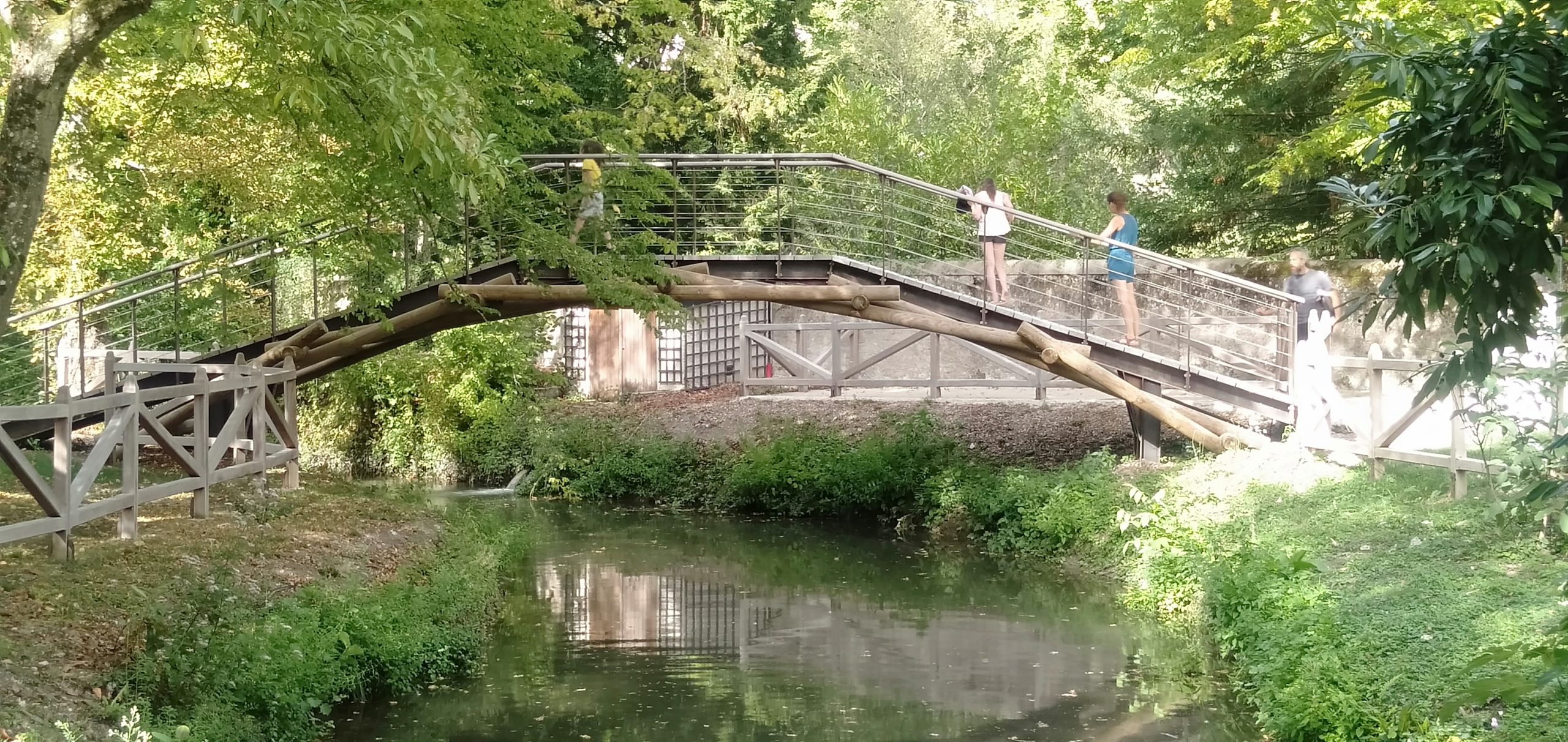
This specific bridge is included in Leonardo’s Codex Atlanticus (pages 69R and 71V). It was originally conceived as a tactical tool to follow or escape from the enemy. The most relevant characteristic of this arched structure is the total absence of nails, screws, or ropes.
- First, the principle of reciprocity: the bridge’s subjection in a vertical position is achieved through the ingenious interlocking of its parts.
- Second, the role of gravity: the weight of the individual timber elements is responsible for joining them together. The greater the load applied to the bridge, the more stable the structure becomes due to increased friction at the contact points.
Why this bridge matters: Timber’s Mechanical Properties
This self-supporting structure is a masterclass in the use of wood as a structural material. It demonstrates that timber is not merely a static element, but a dynamic one that offers:
- Flexibility and Elasticity: the bridge relies on the wood’s ability to bend slightly under load without fracturing. This flexibility allows the arch to settle and distribute weight evenly across the interlocking notches.
- Compressive and Tensile Strength: the design exploits timber’s high strength-to-weight ratio. As an “emergency bridge,” it proves that wood can withstand significant stress while remaining light enough for rapid transport and assembly.
- Dimensional Stability: by relying on friction rather than rigid fasteners, the structure can accommodate minor movements, showcasing the natural resilience of the material.
Technical Conclusion
Leonardo da Vinci’s “emergency bridge” is far more than a historical curiosity. It remains a masterclass in structural economy and serves as a testament to the enduring relevance of timber in high-level engineering. His ability to work in harmony with the laws of physics continues to inspire modern architectural solutions based on reciprocity and modularity.
Related article: Innovació del projecte Ponte Arquato