
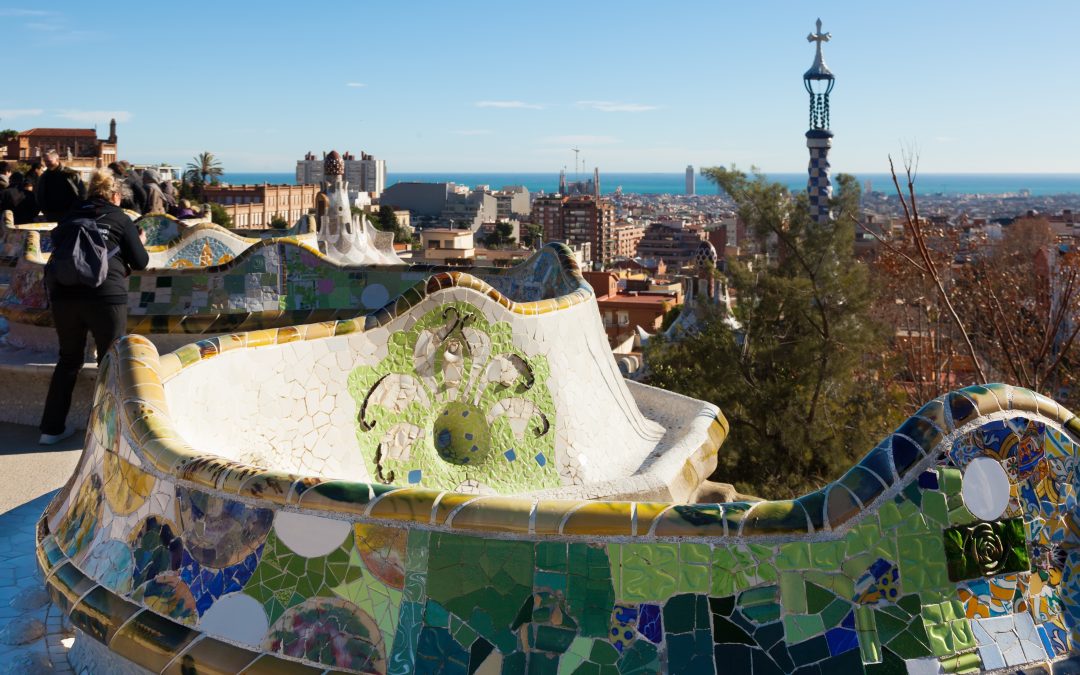
Antoni Gaudí is the most remarkable architect of Catalan Modernism. As the world capital of architecture, Barcelona pays tribute to him in 2026 due to the centenary of his death. Gaudí was an austere professional, fully devoted to his work and his faith.
His main and best-known works are as follows:
The Sagrada Família is Gaudí’s unfinished masterpiece, deeply rooted in symbolism and inspired by nature. His design combines Gothic characteristics with innovative hyperbolic and organic forms. The Nativity Façade is the only one fully executed under Gaudí’s direct supervision. Unfortunately, most of his original drawings were burned during the Spanish Civil War, making it difficult the project’s continuation. As the remaining documents were partial or open to interpretation, the construction has faced several controversies and disagreements. While the project was expected to be finished by 2026, the COVID-19 pandemic delayed progress once again; completion is now projected for 2034.
Located on Passeig de Gràcia, this UNESCO World Heritage Site is a masterpiece built with curved lines and nature-inspired geometry. The main façade resembles waves, suggesting marine life. In its construction, Gaudí utilized a diverse palette of materials, including stone, metal, ceramics, and wood. A primary innovation of the interior design is the optimization of natural light, which, combined with advanced ventilation and ergonomic design, represents a leap forward for its time.
Also situated on Passeig de Gràcia, it is known as La Pedrera because its rough-hewn undulating stone surfaces resemble a quarry. The interior features an irregular, fluid spatial layout inspired by natural forms, integrating large courtyards and light wells to maximize airflow. The rooftop chimneys and ventilation shafts are sculptural, functional, and iconic, representing a perfect fusion of architecture and art.
Although a masterpiece, the project led the Milà family toward financial bankrupt. Gaudí’s ambitious, experimental design required custom craftsmanship which were very expensive. Furthermore, it was misunderstood in its time; the popular «pastel de nata» anecdote reminds us of the family’s frustration—feeling as though they had ordered a simple pastry but received an elaborate, expensive cake instead.
Conceived in 1900 as an ambitious garden-city project. Parc Güell was promoted by the industrialist Eusebi Güell and designed by Gaudí. Originally intended for wealthy families, the project was eventually acquired by the Barcelona City Council in 1922 and transformed into a public park. The monumental core includes the grand staircase, the Dragon Fountain, and the Hypostyle Hall. Gaudí adapted the terraces to the natural terrain, engineering the Hypostyle Hall as a sophisticated water-collection system. The park integrates Catalan identity and religious symbolism with artisanal techniques like trencadís (broken-tile mosaic). It has been a UNESCO World Heritage Site since 1984.
This was Gaudí’s first residential work, located in the Gràcia neighborhood. Designed as a summer residence for Manuel Vicens, the style combines Oriental, Arabic, and Neo-Mudéjar influences. The façade features a great mix of ceramic trencadís, brick, and ornamental ironwork. Among its innovations are Gaudí’s early usage of characteristic symbolism and his unique ability to integrate architecture into the surrounding environment.
I’m preparing a post about Gaudís and wood. If you want to know more, read in a few days in my professional blog why it matters wood to Gaudí.