por Maria Fernandez Alonso | Ene 10, 2026 | Language & Culture
A philological approach to language acquisition and gamification
One of my hobbies is learning languages. That’s why I studied philology a some years ago, and now, to make the most of my available time, I’m learning German with Duolingo. Below, I’d like to share my perspective on this app.
Are you familiar with the Audio-lingual Method?
The Audio-lingual Method was based on the idea of learning a language by creating habits. The teacher, now replaced by the Duolingo app, acts as a model for the repetition of linguistic structures (vocabulary, grammar, and phonology). Regardless of its popularity, the method remains anchored in 1950s habit-formation theories.
Conversely, immersion prioritizes contextual use for superior cognitive acquisition. However, if I had to choose between Duolingo, Candy Crush, or any other similar game, my choice would be clear: Duolingo, since this app has revolutionized access to elementary language acquisition.
Nevertheless, its pedagogical framework is based on substitution translation models. Therefore, this app is only a tool that complements language acquisition which also requires a teacher for explaining grammatical structures and concepts that digital platforms alone cannot provide.
Some people have asked me how, being skeptical, I manage to make progress. However, my progress is an exercise in applied lingüístics. Thanks to my background in English philology, I can decipher Germanic structures. My knowledge of comparative linguistics allows me to overcome the limitations of software, transforming a repetitive exercise into a sophisticated intellectual process that compensates for the shortcomings of digital methodologies. Accordingly, mastering a Language such as German requires a transition from repetition to cognition.
What are the advantages of Duolingo for language learners with no prior linguistic background?
The main advantage of apps such as Duolingo for language learners without prior linguistic experience is that it complements classroom learning. In other words, through short, intuitive micro-lessons, it allows for playful practice of the language being learned.
What are the disadvantages of digital systems like Duolingo?
Basically, without a teacher, it doesn’t work for the reasons given below:
1. Decontextualized syntax. Reliance on isolated sentences prevents students from understanding the fluid logic of word order and cases in German.
2. Structural Phonology. Auditory repetition without a theoretical foundation in phonetics limits the development of authentic pronunciation.
3. Mechanical Translation. The system encourages a «direct association» between languages, ignoring the unique conceptual world inherent in German grammar.
Synthesizing these observations, the limitations of gamified systems become evident when confronted with the structural rigor of any Language. While Technology offers an efficient instrument for preliminar hàbit-formation, the transition to authentic fluency demands a cognitive framework. Ultimately, true lingüístic mastery remains a profoundly human process that requires intellectual depth beyond the scope of corrent digital methodologies.
por Maria Fernandez Alonso | Ene 1, 2026 | Language & Culture
Antoni Gaudí is the most remarkable architect of Catalan Modernism. As the world capital of architecture, Barcelona pays tribute to him in 2026 due to the centenary of his death. Gaudí was an austere professional, fully devoted to his work and his faith.
His main and best-known works are as follows:
La Sagrada Família
The Sagrada Família is Gaudí’s unfinished masterpiece, deeply rooted in symbolism and inspired by nature. His design combines Gothic characteristics with innovative hyperbolic and organic forms. The Nativity Façade is the only one fully executed under Gaudí’s direct supervision. Unfortunately, most of his original drawings were burned during the Spanish Civil War, making it difficult the project’s continuation. As the remaining documents were partial or open to interpretation, the construction has faced several controversies and disagreements. While the project was expected to be finished by 2026, the COVID-19 pandemic delayed progress once again; completion is now projected for 2034.
Casa Batlló
Located on Passeig de Gràcia, this UNESCO World Heritage Site is a masterpiece built with curved lines and nature-inspired geometry. The main façade resembles waves, suggesting marine life. In its construction, Gaudí utilized a diverse palette of materials, including stone, metal, ceramics, and wood. A primary innovation of the interior design is the optimization of natural light, which, combined with advanced ventilation and ergonomic design, represents a leap forward for its time.
Casa Milà (La Pedrera)
Also situated on Passeig de Gràcia, it is known as La Pedrera because its rough-hewn undulating stone surfaces resemble a quarry. The interior features an irregular, fluid spatial layout inspired by natural forms, integrating large courtyards and light wells to maximize airflow. The rooftop chimneys and ventilation shafts are sculptural, functional, and iconic, representing a perfect fusion of architecture and art.
Although a masterpiece, the project led the Milà family toward financial bankrupt. Gaudí’s ambitious, experimental design required custom craftsmanship which were very expensive. Furthermore, it was misunderstood in its time; the popular «pastel de nata» anecdote reminds us of the family’s frustration—feeling as though they had ordered a simple pastry but received an elaborate, expensive cake instead.
Parc Güell
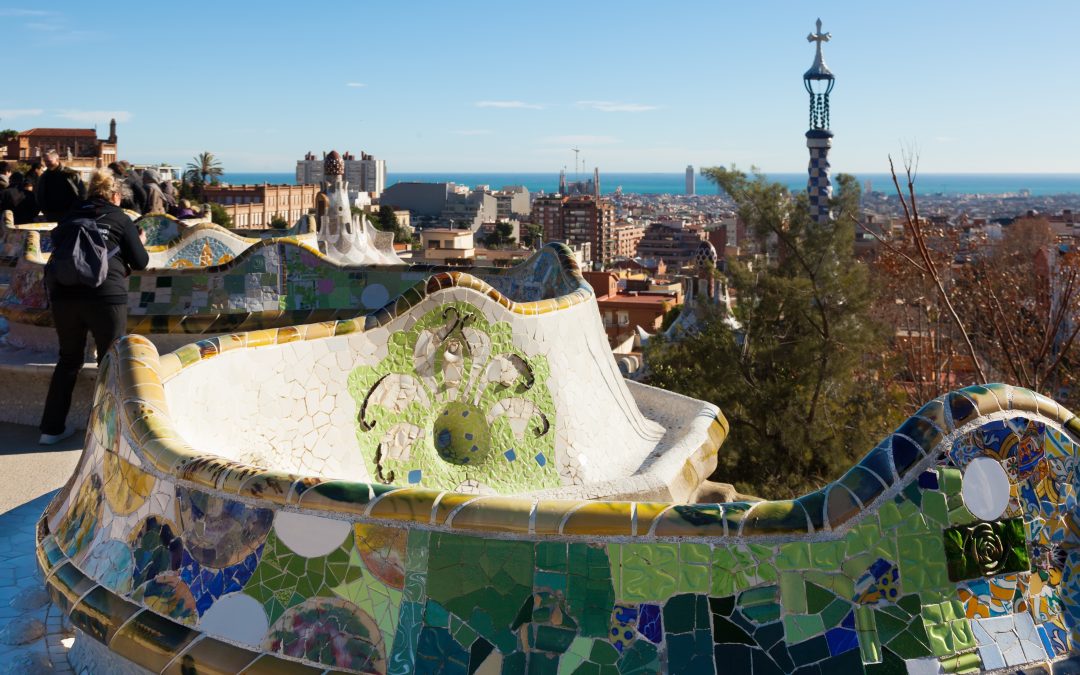
Conceived in 1900 as an ambitious garden-city project. Parc Güell was promoted by the industrialist Eusebi Güell and designed by Gaudí. Originally intended for wealthy families, the project was eventually acquired by the Barcelona City Council in 1922 and transformed into a public park. The monumental core includes the grand staircase, the Dragon Fountain, and the Hypostyle Hall. Gaudí adapted the terraces to the natural terrain, engineering the Hypostyle Hall as a sophisticated water-collection system. The park integrates Catalan identity and religious symbolism with artisanal techniques like trencadís (broken-tile mosaic). It has been a UNESCO World Heritage Site since 1984.
Casa Vicens
This was Gaudí’s first residential work, located in the Gràcia neighborhood. Designed as a summer residence for Manuel Vicens, the style combines Oriental, Arabic, and Neo-Mudéjar influences. The façade features a great mix of ceramic trencadís, brick, and ornamental ironwork. Among its innovations are Gaudí’s early usage of characteristic symbolism and his unique ability to integrate architecture into the surrounding environment.
I’m preparing a post about Gaudís and wood. If you want to know more, read in a few days in my professional blog why it matters wood to Gaudí.
por Maria Fernandez Alonso | Dic 7, 2025 | Language & Culture
¿Cuántas veces has errado al expresarte correctamente en inglés?
¿Cuánta veces te has preguntado es «to leave» o «give up»?
Language Nuance: Understanding ‘To Leave’ vs. ‘Give Up’
Comenzaré con una anécdota reciente:
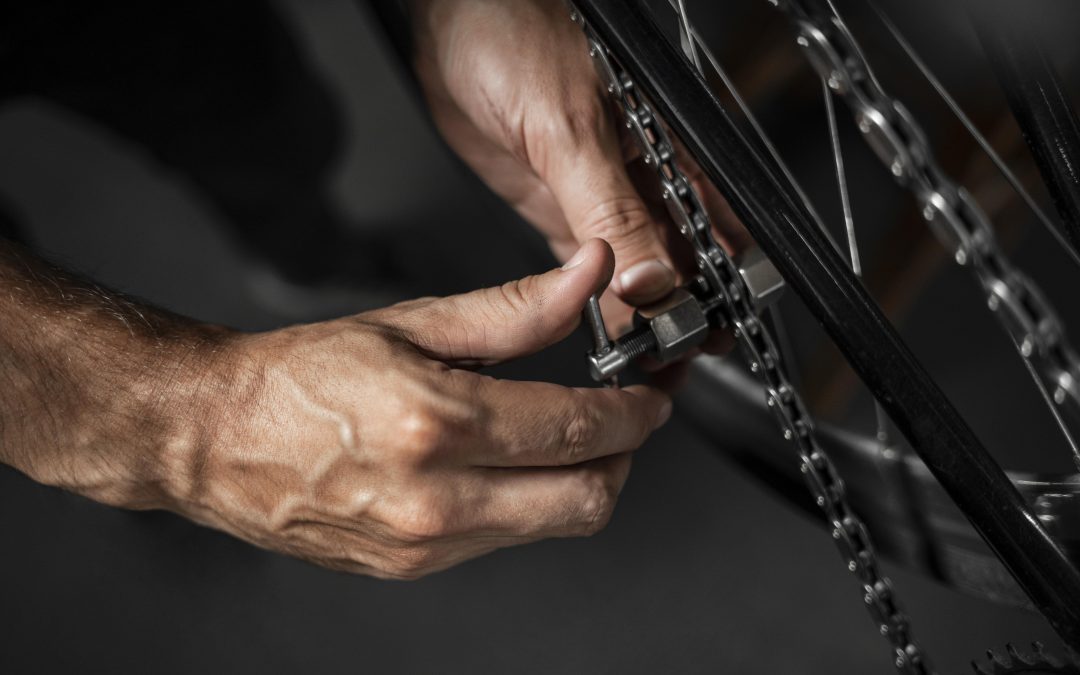
En mi última excursión de bici uno de los participantes tuvo la mala suerte de romper la cadena de su bicicleta. Intentamos repararla sin éxito durante largo rato hasta que el propio afectado dijo al ver que la reparación no avanzaba — dejémoslo. A continuación me miró a mi y preguntó: ¿Cómo se diría en inglés?
Mientras yo respondía «give up» otros respondieron «leave it» y esta situación me hizo pensar que sería interesante explicar la diferencia en un post.
Tanto en castellano (dejar) como en catalán (deixar) se utiliza el mismo verbo con sentido de dejar algo en algún sitio concreto, en algún punto concreto como para indicar rendición o abandono. Sin embargo, en inglés la expresión es diferente.
«To leave« implica una situación estática, de quietud, parada o no intervención. Se usa en contextos genéricos para hacer referencia a parar, a dejar una cosa en el mismo sitio que está, a no hacer nada más al respecto de una situación o asunto determinado. Requiere una separación física y un cese temporal.
«Give up» es una «phrasal verb» y se utiliza en contextos que implican «tirar la toalla«. Se utiliza en situaciones activas y frecuentemente difíciles que conllevan la rendición de la lucha. También se utilizan con relación al control de un mal hábito que ha sido dominado.
Tras esta explicación os dejo algunos ejemplos para que decidáis si usarías «to leave» o «give up»
1. ………………………………….. this project, now we have to focus our attention in preparing tomorrow’s exam
2. My sister told me that she …………………………………..smoking, however, she doesn’t succeed
3. I decice not to apply for the public service position. The test was to hard. I …………………………………..
4. Do not insist in going out tonight, tomorrow I’ve to get up early …………………………………..
¿Al elegir tus respuestas has pensado en los contextos descritos?
¿Sabes cuál es el test para no fallar?
Si te refieres a un objeto, lugar o tarea que se pueda interrumpir temporalmente, será «to leave» mientras que si te refieres a una adicción, a un mal hábito, a un sueño descartado, a una acción que conlleva tu rendición, entonces usa «give up«
Y el test definitivo
1. Leave it: se interrumpe una tarea temporalmente
2. Give up: cese de un hábito difícil
3. Give up: rendición ante un objetivo o lucha
4. Leave it: cese en la insistencia sobre una temática
Es decir, para evitar errores, céntrate en la semántica. Entender el significado te ayudará a realizar la elección correcta a por tanto, a expresarte con precisión.
Espero haberte ayudado y que mi explicación haya servido para que no te vuelvas a equivocar. Si tienes alguna otra duda, déjame tu pregunta en comentarios y, la duda que se repita con mayor frecuencia, ser la protagonista de mi próxima publicación.

por Maria Fernandez Alonso | Sep 25, 2025 | Language & Culture
Dime cómo hablas y te diré quién eres… George Bernard Shaw en Pigmalión exploró cómo el lenguaje denota la posición social porque éste modela la identidad individual y grupal. Hablar bien nos hace libres: permite pensar con claridad, expresarnos con precisión y escuchar sin prejuicios. Esta gran obra es también muy crítica con el sistema educativo de la época.
Padres y docentes deberíamos reflexionar con urgencia y preguntarnos por qué, teniendo más medios que en ningún otro momento de la historia, el nivel de comprensión del lenguaje disminuye progresivamente. ¿Cómo es posible que nativos digitales no sepan utilizar una fotocopiadora? ¿O que sean incapaces de comprender instrucciones básicas en una aplicación? ¿Por qué se ha perdido la capacidad de leer con atención, de seguir una secuencia lógica, de interpretar un texto más allá del titular?
Actualmente, el uso de la lengua española se ha convertido en una auténtica paradoja. Con 500 millones de hablantes, presente en medios, redes, plataformas y entornos educativos, se emplea cada vez con menos rigor, sin criterios de corrección, precisión ni coherencia. Lo que antes era un error, se ha convertido en una variante y lo que antaño se corregía, hoy, se viraliza.
Frecuentemente se utilizan construcciones que rompen con el principio de economía del lenguaje y reflejan un profundo desconocimiento del lenguaje. Incapaces de proporcionar el máximo de información con el mínimo de palabras se magnifica la redundancia:
“¿Cómo cuánto tiempo tardas en hacer tus deberes?” en lugar de “¿Cuánto tardas?”
“¿Qué tan difícil fue tu examen de matemáticas?” en vez de “¿Fue difícil tu examen?”
“¿Cómo qué tan seguro es este método?” en vez de “¿Es seguro este método?”
“¿Qué tan lejos está tu casa?” en lugar de “¿A qué distancia está tu casa?”
Estas fórmulas, que se repiten por influencia de medios y redes sociales, no solo empobrecen el idioma: entorpecen la comunicación. Se pierde claridad, se diluye el mensaje y se normaliza una sintaxis que no responde a la lógica del español culto.
Lo más preocupante es que el error se perpetúa no solo en el habla cotidiana, sino también en el desarrollo de aplicaciones educativas y contenidos digitales que, en su versión castellana, están incorrectamente programadas. Es decir, estamos abandonando el patrimonio del español normativo para normalizar fórmulas lingüísticas que triunfan por su sonoridad o por su impacto viral.
El resultado es un empobrecimiento léxico, gramatical y expresivo. Se reduce el vocabulario activo, se simplifican las estructuras, se pierde la capacidad de matizar. Y con ello, se debilita el pensamiento.
Hablar bien no es un lujo. Es una forma de pensar bien, de hacerse respetar, de construir ciudadanía. Dominar el propio idioma es una responsabilidad compartida: de los docentes, que deben enseñar con rigor; de las familias, que deben corregir y acercar a la cultura; y de cada individuo, que debe elegir lecturas de calidad, libros y artículos bien escritos, que además de enriquecer el léxico, permiten dominar las estructuras lingüísticas. Escuchar programas culturales, entrevistas bien conducidas, conferencias y debates también contribuye a educar el oído y afinar el pensamiento.
Porque como bien nos enseñó Shaw, el lenguaje, además de describirnos, nos define. Y ahora que te lo he contado, tú decides…

por Maria Fernandez Alonso | Jun 28, 2025 | Language & Culture
Superar el nivell més alt de català no només és un repte personal, sinó també una eina clau per créixer i connectar millor amb el meu entorn.
La meva història amb la llengua catalana va començar quan tenia cinc anys, en arribar a Barcelona i adonar-me que parlaven diferent de com jo ho feia llavors. Així que li vaig preguntar a la meva cuidadora: Quan parlaré en català? La seva resposta va ser que necessitava temps i pràctica, i que per començar podia aprendre aquest embarbussament:
«Setze jutges d’un jutjat mengen fetge d’un penjat. Si el penjat es despenja, els setze jutges del jutjat no podran menjar més fetge del penjat.«
En aquella època, tot i que els meus veïns eren catalans, jo no escoltava gaire el català al carrer i, a més —malgrat la imatge que sovint es té dels catalans fora de Catalunya— a mi sempre em parlaven en castellà. I va ser així durant gairebé quinze anys. A més, vaig estar escolaritzada en castellà i, en arribar a la universitat, havent triat Turisme i després Filologia, l’ensenyament va ser multilingüe.
Feia anys que volia avançar i treure’m el C2, principalment pel plaer d’aprendre i perquè la llengua és part de la meva identitat, tot i que vaig néixer a Austràlia i el meu origen familiar és asturià. Finalment, el setembre passat vaig tenir l’oportunitat d’inscriure’m i començar el curs al CPNL de la Generalitat de Catalunya. Aquest mes de juny ho he superat, cosa que m’ha omplert de felicitat.
El nivell C2 acredita una competència lingüística excel·lent, tant oral com escrita. Permet expressar-se amb precisió, matisos i fluïdesa en qualsevol context, sigui professional, acadèmic o social. A més, implica dominar registres formals i informals, comprendre textos complexos i argumentar amb coherència i riquesa lèxica.
Han estat mesos d’esforç, constància i molta pràctica. Aquest assoliment representa molt més que una acreditació: és una fita que reflecteix el meu compromís amb la llengua i la cultura catalana. I, arribat aquest punt, vull afegir que això no s’acaba aquí: ara disposo de més eines i recursos per continuar millorant. És a dir, superar el C2 no és pas un punt final, sinó una fita simbòlica en un camí que continua. Les llengües són vives, complexes i sempre vives. Ara em toca continuar llegint, parlant, escoltant i aprenent —amb la mateixa curiositat i estima que m’hi han portat fins aquí.
Per això mateix, m’he inscrit al Voluntariat per la llengua. Em fa especial il·lusió començar aquesta nova etapa, perquè sé que compartir la llengua amb algú altre també és una manera de continuar aprenent. Quan expliques, descobreixes. Quan escoltes, t’enriqueixes. I en cada conversa, per senzilla que sigui, hi ha una oportunitat de créixer. Aquesta nova aventura, plena de complicitats i descobertes, la compartiré amb vosaltres més endavant al blog. Segur que tindré molt per explicar.
En conjunt, en un món cada cop més globalitzat, on sovint es prioritzen llengües majoritàries com el castellà, l’anglès o el francès – que també formen part del meu dia a dia-, tenir un domini alt d’una llengua com el català és un valor afegit. Fer-lo servir a casa nostra reforça la confiança a l’hora de comunicar-se amb claredat i eficàcia. Aquesta certificació també és una manera de valorar la diversitat lingüística i cultural del meu entorn i, sens dubte, una forma de demostrar arrelament, sensibilitat cultural i capacitat d’adaptació. En conclusió, parlar català és més que parlar un idioma: és ser part activa d’una comunitat.

por Maria Fernandez Alonso | May 30, 2025 | Language & Culture
Quantes vegades t’has preguntat si no seria més fàcil que tots ens comuniquéssim en un sol idioma?
Però… renunciaries a la teva cultura i a la teva llengua materna? A tot allò que et defineix com a persona? A la teva identitat?
Per a mi, parlar idiomes no només és imprescindible, sinó que ha estat una palanca estratègica en la meva trajectòria professional. Recordo una anècdota que encara em fa somriure: quan vaig començar a treballar al Gremi Fusta i Moble, algú del meu entorn va comentar amb ironia: “Tants anys amb l’anglès… i ara el que et valoren és el teu català!” El que em va quedar d’aquell comentari és que cap llengua és superior a una altra: totes són valuoses. L’anglès m’ha obert portes en tots els àmbits de la vida, però el català ha estat clau per connectar amb el meu entorn, marcat per una pluralitat lingüística que forma part del meu ADN des del primer dia.
Amb disset anys vaig convèncer els meus pares per enviar-me al país on havia nascut, Austràlia. Allà, per immersió, vaig aprendre ràpidament l’anglès com a segona llengua. Al meu retorn, aquest domini em va convertir en una privilegiada: aleshores, pocs tenien aquest nivell d’anglès, i això em va obrir moltes oportunitats. Tant és així que, a l’oficina d’ocupació (avui SEPE), vaig haver de demanar que em fessin una prova abans de descartar-me pel meu jovent. No només havia après una llengua: havia après a defensar la meva vàlua. I així vaig aconseguir entrar a la segona empresa de tecnologia de la informació més gran del món després d’IBM.
En tornar, ho vaig fer coneixent tant les meves fortaleses com les meves febleses. Per això vaig optar per continuar formant-me, i de fet, ho faré tota la vida. Primer vaig estudiar Turisme, que m’oferia l’oportunitat d’aprofundir en l’anglès, aprendre francès i adquirir una visió global d’administració i direcció d’empreses. Aquests coneixements em van ser molt útils anys després com a emprenedora i cofundadora de dos projectes: un d’externalització de serveis i un altre de comunicació digital. Després d’obtenir la diplomatura en Turisme, em vaig llicenciar en Filologia Anglesa i, enguany, estic satisfeta d’haver superat les proves del C2 de català.
Els idiomes són el meu valor diferencial. Són la clau que em permet oferir un plus al meu perfil: habilitat per establir connexions autèntiques, comunicar amb claredat, entendre millor els altres i adaptar-me amb agilitat a entorns diversos. Aquestes habilitats han enriquit totes les organitzacions on he col·laborat i han estat essencials per generar vincles més enllà de la gestió de projectes.
Per això, vull convidar-te a reflexionar sobre el paper que tenen els idiomes en la teva vida professional. Aprendre llengües no és només útil: és apassionant. Com més idiomes, més perspectives; com més perspectives, més solucions. I en un món global que demana empatia, adaptabilitat i mirada àmplia, això no és cap luxe: és una necessitat.