
The renowned American architect Michael Sorkin conceptualised urban thematization through his analysis of the city as a theme park. His influential work explored the relationship between urban development, globalisation, and the public realm.
Cities should primarily serve the people who inhabit them. However, touristification can transform living urban environments into spaces increasingly oriented towards visitors. Tourists may consequently consume carefully curated representations of the past while having limited engagement with the living culture of the place.
As this process intensifies, urban diversity may give way to standardisation, while local cultural identity becomes increasingly shaped by external expectations. The city can consequently become a stage for short-term leisure and entertainment designed primarily for transient visitors.
The fundamental question is therefore: whose interests and needs ultimately shape the urban environment?
Mechanisms of Urban Thematization
The Tourist Backdrop
Heritage can lose much of its original social and community context when architecture is transformed into a photogenic backdrop for digital consumption. Building façades may be preserved as aesthetic shells while residential interiors are converted into holiday apartments, boutique hotels, or commercial premises.
A paradoxical form of historic preservation can consequently emerge: the physical appearance of the city is maintained while the social fabric that gave these places their meaning gradually disappears.
Commercial Standardisation and Public Space
Tourist-oriented businesses may increasingly dominate historic city centres, while commercial premises are adapted to facilitate rapid and predictable consumption. International visitors can encounter familiar franchises and standardised experiences in destinations across the world.
Local gastronomy and cultural practices may consequently adapt to external expectations rather than evolving primarily in response to the needs of the resident population. When traditions become marketable stereotypes, their connection with everyday community life may weaken.
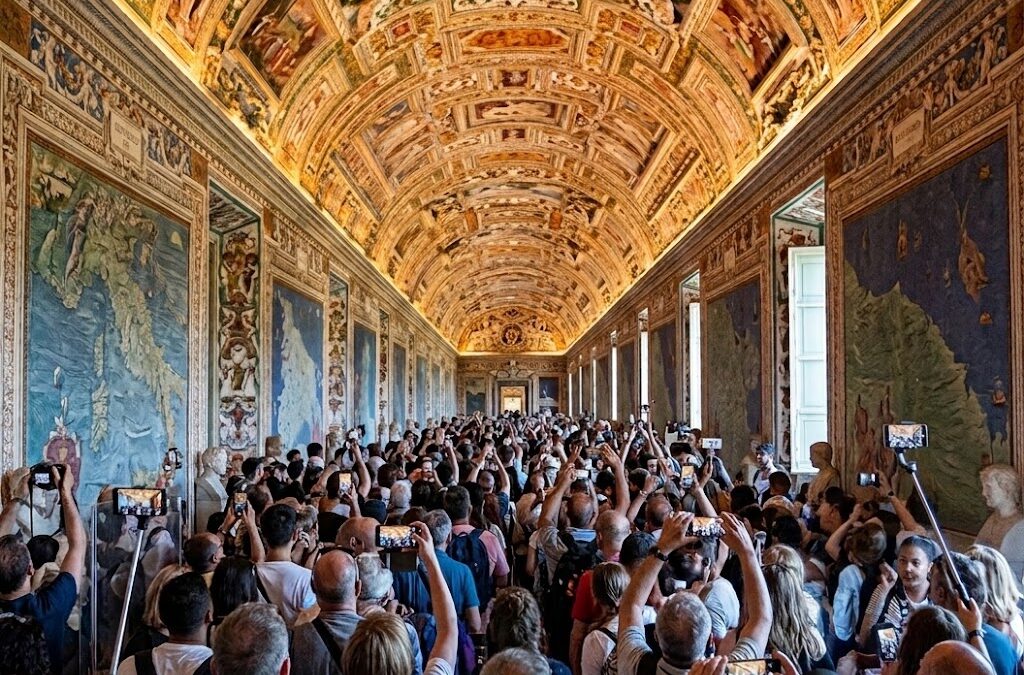
This process of urban thematization can also reshape public space which undergo a similar transformation. Streets may increasingly function as crowded transit corridors rather than places for everyday social interaction. High visitor density can also create conditions that facilitate petty crime, while measures introduced to manage overcrowding may restrict public access.
For instance, Rome has introduced measures to regulate access to the Trevi Fountain, while visitor-management systems are also used at highly congested sites such as the Sistine Chapel in Vatican City.
Economic Precarity and Professional Qualification
Excessive dependence on tourism can restrict local economic diversity and increase exposure to external shocks. It may also contribute to employment precariousness, particularly in sectors characterised by seasonal demand.
However, hospitality occupations are not inherently low-skilled. They require a wide range of technical, linguistic, organisational, and interpersonal skills. The quality of a restaurant depends not only on its food but also on the expertise of its chefs and kitchen staff and the professionalism of those responsible for interacting with customers.
By contrast, global franchises rely on highly replicable products, processes, branding, and customer experiences. Their consistency may offer convenience and predictability, but it can also contribute to the homogenisation of urban commercial environments.
Italian cuisine provides a familiar example. Italian food is now available almost everywhere in the world, while distinctive culinary traditions remain deeply rooted in individual regions and local communities. The challenge is therefore not the international dissemination of a cuisine, but the replacement of local culinary diversity by standardised commercial experiences.
Structural Vulnerability
Heavy dependence on international tourism can increase a city’s exposure to external shocks. Geopolitical instability, economic crises, global pandemics, or major disruptions to international transport can rapidly alter travel patterns and consequently affect local economies.
Tourism creates employment, investment, and economic opportunities, but excessive dependence on visitors can also generate structural vulnerability when alternative economic activities and resident-oriented functions have been progressively displaced.
The cumulative effects of urban thematization can therefore require strengthening productive diversity is therefore essential to building urban economic resilience and reducing dependence on a single economic sector.
Governance Strategies for Urban Rebalancing
Land-use Regulations and Master Plans
Cities can limit holiday accommodation licences and protect sufficient residential capacity through appropriate planning instruments. Such measures can help preserve long-term housing availability and reduce speculative pressure in areas experiencing intense demand.
Protection of Local Commerce
Municipalities can safeguard historic businesses and essential everyday services through planning regulations, commercial protection measures, and other instruments designed to counter excessive pressure from property speculation and large-scale commercial chains.
Protecting local retail can help maintain both the economic diversity and the social function of urban areas.
Decentralisation of Saturated Tourism Hubs
Redirecting visitor flows can distribute tourism-related pressures more evenly across different parts of a city. However, decentralisation alone cannot resolve the structural problems associated with touristification.
Transferring visitors to previously less-visited areas may generate new demand for housing, transport, infrastructure, and public services. Spatial redistribution should therefore be accompanied by comprehensive planning to prevent the displacement of pressure from one area to another.
Promotion of Long-Term Residential Rentals
Public policies can increase the supply of social and affordable housing while regulating short-term tourist accommodation. Effective enforcement against the illegal conversion of residential properties into tourist accommodation can also help protect the long-term rental market.
These measures can contribute to greater residential stability and preserve the capacity of cities to accommodate their permanent populations.
Economic Diversification and Productive Resilience
Municipalities can support economic diversification by fostering sectors such as technology, research, creative industries, and local craftsmanship. Targeted incentives can encourage stable, higher-value employment beyond hospitality and other visitor-oriented activities.
A more diversified productive base can reduce exposure to international tourism shocks and strengthen the long-term resilience of the urban economy.
Participatory Governance and Civic Engagement
Permanent residents should have meaningful opportunities to participate in decisions affecting land use, tourism management, housing, and public space.
Participatory mechanisms can help determine acceptable levels of visitor activity and ensure that urban policies reflect the needs of the people who live in the city permanently. Effective urban governance should therefore treat residents not merely as stakeholders, but as active participants in shaping their shared environment.